

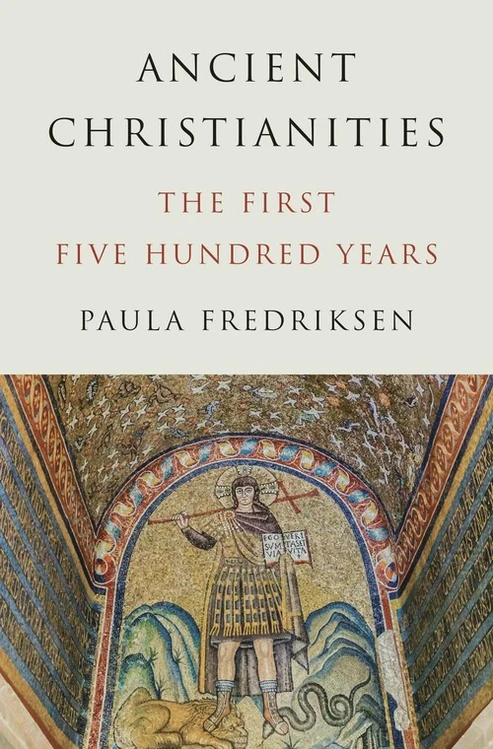
There is no single christianity. Adherents to the faith have disagreed over doctrine and practice from the beginning. They continue to disagree in the present day. At times they have disagreed so vehemently that they have burned, butchered and persecuted each other over the centuries. There are at least 45,000 denominations of christianity in the world today, each proposing variations of doctrine which are incompatible with the others (Christian Denominations: A List of All 46 Types of Christianity).
Paula Fredriksen (Paula Fredriksen | Department of Religion) is one of the world’s foremost New Testament scholars. Her expertise lies in the history of early christianity. In this book she shows that early christian communities had vastly differing views on theology, scripture, and practice. She highlights that the ultimate dominance of one singular creed and one specific church in the late Roman Empire was not due to inherent correctness, but rather the convergence of Roman civic duty with Jewish apocalyptic monotheism.
Fredriksen shows that labels like “Jewish,” “Christian,” and “pagan” were not rigid, fixed identities in antiquity. Instead, they were highly fluid concepts that people continually negotiated, re-imagined, and crossed over.
Alongside the formal, institutional church run by bishops and theologians, there existed an everyday popular religion. Ordinary christians routinely integrated amulets, protective spells, magic, and ancestral rituals for the dead into their faith, despite the frequent condemnation of local clergy.
An important argument of the author is that the standardisation of the faith was fundamentally driven by political power. When Emperor Constantine converted to Christianity in 312 CE, the Roman state’s historical emphasis on religious conformity to protect the empire was mapped onto the church. Under imperial endorsement, one type of church became “Orthodox,” while all other competing Christian practices were criminalised and suppressed.
Fredriksen also covers the ascetic movements. The Desert Fathers, celibacy advocates, and rigorous fast-keepers, held massive spiritual authority in early Christian writings. However, their charismatic authority frequently clashed with the legalistic authority of city bishops.
There are insights worth having on every page of this superb work.
288 pages in Princeton University Press
First published 2024
ISBN-13 : 978-0691157696

Paula Fredriksen